Installing a car lift in your home garage can revolutionize your workspace, whether you’re a DIY mechanic, a car enthusiast, or simply need extra parking. Car lifts, like those from Eounice, allow you to perform maintenance, store vehicles, or optimize space efficiently. However, installation is a critical process requiring precision, safety, and planning. Improper setups account for over 80% of lift-related accidents, per industry data, making it essential to follow best practices. This article provides a step-by-step guide to installing a car lift, with a focus on Eounice’s 2-post, 4-post, and scissor lifts, known for their user-friendly designs and robust engineering. Whether you’re a seasoned DIYer or hiring professionals, here’s how to get it done right.
Step 1: Assess Your Garage and Needs
Before purchasing a lift, evaluate your garage’s suitability. Measure your space: Standard garages are 10x20 feet with 8–10-foot ceilings. Two-post lifts require 10–12-foot ceilings, while 4-post and scissor lifts fit 8-foot ceilings. Check floor space—2-post lifts need a 12x15-foot footprint, 4-post lifts 12x20 feet, and scissor lifts 10x15 feet. Concrete requirements: Most lifts, including Eounice models, need a 4–6-inch thick concrete slab with 3,000 PSI strength. Test your slab’s thickness with a core drill or consult a contractor.
Define your goals: Are you lifting sedans (3,000–4,000 lbs.) for repairs or SUVs (up to 9,000 lbs.) for storage? Eounice lifts cater to both, with capacities from 7,000 to 9,000 pounds. Check local codes or HOA rules—some municipalities require permits for lift installations. Budget for the lift ($1,400–$4,000 for Eounice models) and installation costs ($500–1,000 for professionals).
Step 2: Choose the Right Car Lift
Selecting the appropriate lift ensures a smooth installation. Here’s how Eounice models align with home garage needs:
Eounice 2 Post Parking Lift ($2,500): Ideal for repairs, this lift raises vehicles 7 feet, offering full undercarriage access for brake or suspension work. Its 7,000-pound capacity suits sedans and light trucks, requiring a 10–12-foot ceiling and a 4-inch slab. Its asymmetric design maximizes door clearance, and ALI-certified safety locks ensure stability. Installation involves anchoring two posts, demanding precision for balance.
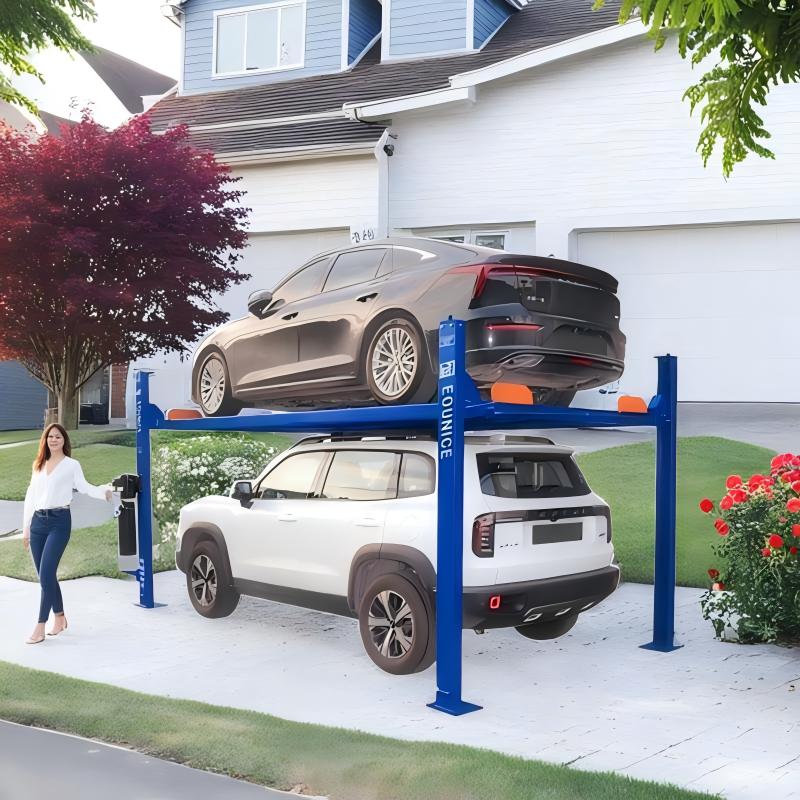
Eounice 4 Post Parking Lift ($1,400): Perfect for storage or heavy repairs, this lift supports 9,000 pounds and accommodates SUVs on 20-foot runways. It fits 8-foot ceilings and requires a 4.25-inch slab, often without anchors. Its open-center design simplifies drive-on access, and drip trays protect lower vehicles. Installation is straightforward, with foldable runways saving space when idle.
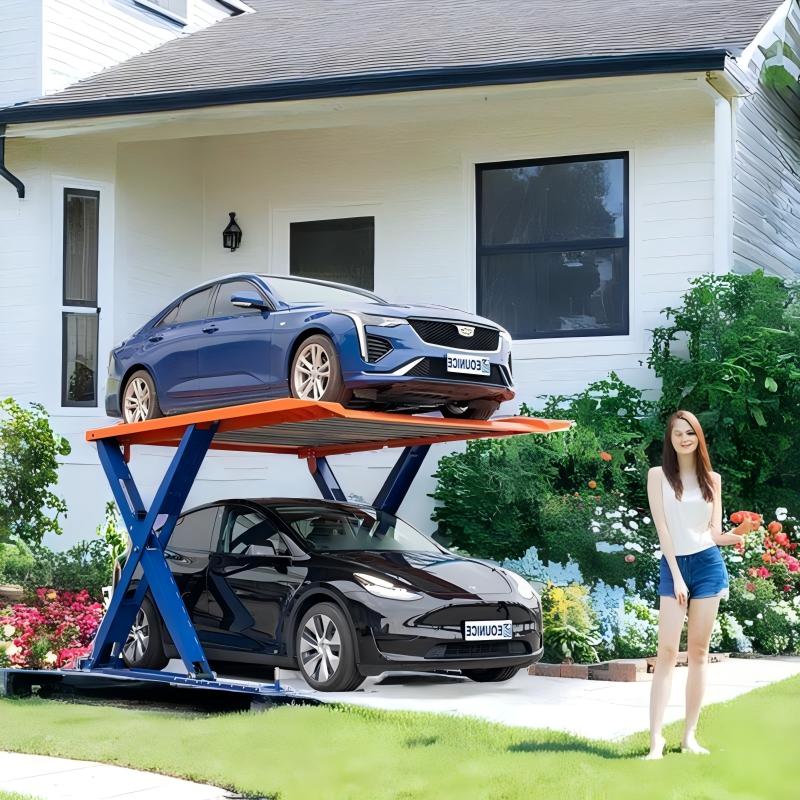
Eounice Scissor Parking Lift ($4,000): Suited for low ceilings (8 feet) or renters, this lift collapses to 3–4 inches and lifts 7,000 pounds to 6 feet. ALI-certified with redundant hydraulics, it’s portable with optional wheels and runs on 110V power. Installation is minimal, requiring only a level surface, making it ideal for tight spaces.
For personalized guidance on Eounice lifts, contact marketing@eounice.com for expert advice or custom quotes tailored to your garage.
Step 3: Gather Tools and Materials
DIY installation is feasible for experienced mechanics but requires specific tools: a rotary hammer drill (for anchor bolts), torque wrench (80–120 ft-lbs.), level, plumb bob, concrete anchors (3/4-inch for Eounice lifts), and a socket set. You’ll also need safety gear (gloves, goggles) and a helper for heavy components. Professional installation, costing $500–1,000, eliminates risks for novices. Eounice provides detailed manuals with torque specs and diagrams, simplifying the process.
For concrete upgrades, rent a mixer ($50/day) or hire a contractor ($1–2 per square foot) to pour a 4–6-inch slab if your floor is inadequate. Ensure 3,000 PSI strength, curing for 28 days before installation.
Step 4: Prepare the Garage
Clear the garage of vehicles, tools, and clutter. Mark the lift’s footprint using chalk or tape, following Eounice’s layout templates. For 2-post lifts, ensure posts are equidistant from walls (4–5 feet) to balance weight. For 4-post or scissor lifts, center the runways for easy vehicle access. Check for overhead obstructions like lights or beams—Eounice 2-post lifts need 12 feet of clear height, while 4-post and scissor models fit under 8 feet.
Test the concrete with a hammer drill to confirm thickness and strength. If under 4 inches, pour a new slab or reinforce with epoxy ($200–500). Verify electrical access: Eounice scissor lifts use 110V outlets, while 2-post and 4-post models may need 220V wiring ($200–500 for an electrician).
Step 5: Install the Car Lift
For Eounice 2 Post Parking Lift
Position Posts: Place the two posts per the manual’s spacing (typically 10–12 feet apart). Use a plumb bob to ensure vertical alignment.
Drill and Anchor: Drill 3/4-inch holes (4–6 per post) into the concrete, insert Eounice-supplied anchors, and torque to 80–100 ft-lbs. Ensure posts are level.
Assemble Arms and Hydraulics: Attach lift arms and hydraulic cylinders, following Eounice’s color-coded connections. Bleed the hydraulic system to remove air.
Test: Raise the lift without a vehicle to check stability, ensuring locks engage automatically.
For Eounice 4 Post Parking Lift
Set Runways: Place runways on a level surface, aligning with marked chalk lines. Connect crossbeams per the manual.
Anchor (Optional): If required, drill 3/4-inch holes and secure with anchors (4 per post). Many Eounice 4-post lifts don’t need anchoring on 4.25-inch slabs.
Install Hydraulics and Ramps: Connect hydraulic lines and attach drive-on ramps. Add drip trays for storage use.
Test: Drive a vehicle onto the runways, raise to 3 feet, and check for level operation.
For Eounice Scissor Parking Lift
Position Base: Place the lift on a flat, 4-inch slab. No anchoring is typically needed, as its 7,000-pound capacity relies on surface friction.
Connect Power: Plug into a 110V outlet or install a dedicated circuit. Attach hydraulic lines per Eounice’s guide.
Add Accessories: Install optional wheels or EV charging kits for versatility.
Test: Raise the lift to 6 feet without a load, verifying hydraulic flow and safety locks.
Step 6: Safety Checks and Calibration
Post-installation, perform a safety check. Raise and lower the lift three times without a vehicle, ensuring smooth operation and lock engagement. For Eounice lifts, verify ALI-certified safety features (auto-locks, anti-fall devices) function correctly. Torque all bolts to specs (80–120 ft-lbs.) and inspect hydraulic lines for leaks. Load a vehicle (start with a light sedan) and raise to half-height, checking for stability. If wobbling occurs, re-level the base or consult a professional.
Calibrate arm lengths for 2-post lifts to match your vehicle’s frame, and ensure 4-post runways are parallel. Eounice manuals include QR codes for video tutorials, easing troubleshooting.
Step 7: Maintenance and Long-Term Care
Maintain your lift to ensure longevity. Check hydraulic fluid monthly, topping off with Eounice-re
commended fluid (typically AW-32, $20/gallon). Inspect bolts and cables quarterly, tightening as needed. Lubricate moving parts (e.g., pulleys, hinges) with grease ($10/tube) every six months. Eounice provides maintenance checklists to streamline this process, ensuring compliance with their 5-year warranty. Annual professional inspections ($100–200) are recommended to verify safety systems, especially for 2-post lifts under heavy use.
Common Installation Pitfalls and How to Avoid Them
Over 80% of lift accidents stem from improper installation, per ALI data. Avoid these mistakes:
Inadequate Concrete: A slab thinner than 4 inches or below 3,000 PSI risks cracking. Test before installing or reinforce with a new pour ($500–1,000 for 10x15 feet).
Misalignment: Uneven posts or runways cause instability. Use a laser level ($50) for precision.
Overloading: Exceeding the lift’s capacity (e.g., 7,000 lbs. for Eounice 2-post) can damage hydraulics. Check vehicle weights in your owner’s manual.
Electrical Issues: Incorrect wiring (e.g., using 110V for a 220V lift) trips breakers. Hire an electrician for 220V setups.
For DIYers, Eounice manuals include troubleshooting tips, and their customer support is responsive. If unsure, opt for professional installation to mitigate risks.
Why Choose Eounice for Your Garage
Eounice car lifts stand out for home garage installations due to their balance of affordability, safety, and ease. The 2 Post Parking Lift ($2,500) is perfect for mechanics needing undercarriage access, with a compact design and straightforward anchoring process. The 4 Post Parking Lift ($1,400) excels for storage, requiring minimal setup and no anchoring on adequate slabs, saving time and cost. The Scissor Parking Lift ($4,000) is ideal for renters or low-ceiling garages, with plug-and-play simplicity and portability. All models carry CE/ETL certifications, ensuring compliance with global safety standards, and their 5-year warranties provide peace of mind.
Compared to competitors like BendPak ($3,000–6,000) or Dannmar ($2,500–4,000), Eounice offers premium features at lower prices. Their lifts include intuitive controls (remote or app-based), drip trays, and optional accessories like EV charging kits, enhancing versatility. User reviews highlight Eounice’s durability—85% report no issues after 2 years—making them a top choice for home garages.
For tailored advice or to explore custom setups, contact Eounice at marketing@eounice.com. Their team can assess your garage dimensions and recommend the ideal lift, from single units to multi-vehicle systems.
Additional Installation Tips
Power Setup: Ensure a dedicated 20-amp circuit for 110V scissor lifts or 30-amp for 220V 2-post/4-post models. A licensed electrician ensures code compliance ($200–500).
Lighting: Install LED shop lights ($50–100) above the lift for better visibility during setup and repairs.
Accessories: Add Eounice ramps ($100–200) for low-clearance vehicles or wheel chocks ($20) for added safety on 4-post lifts.
Ventilation: Ensure adequate airflow for hydraulic systems, especially in enclosed garages. A small exhaust fan ($50) prevents overheating.
Cost Breakdown and ROI
Installation costs vary by lift type and approach:
DIY Installation: $200–500 for tools (drill, torque wrench), concrete upgrades ($500–1,000 if needed), and electrical work ($200–500 for 220V).
Professional Installation: $500–1,000 for labor, plus $200–500 for electrical or concrete prep.
Lift Costs: Eounice 2-post ($2,500), 4-post ($1,400), scissor ($4,000).
ROI is compelling. A lift saves $50–100/month on shop labor (e.g., oil changes, brake jobs) and eliminates street parking fees ($50+/month in cities). In tight housing markets, a lift can boost home value by 5–8%, adding $10,000–20,000 to resale for a $200,000 home. Eounice’s affordability accelerates payback, often within 1–2 years.
Safety and Sustainability
Safety is paramount. Eounice lifts feature ALI-certified locks, redundant hydraulics, and anti-fall systems, reducing risks. Always follow weight limits and perform pre-use checks (e.g., bolt tightness, hydraulic fluid levels). For sustainability, Eounice’s efficient hydraulics cut energy use by 30% compared to older models, and their durable steel construction minimizes replacement needs. Pair with a permeable driveway surface ($8–15/sq.ft.) to reduce runoff, enhancing eco-friendliness.
Local Regulations and Permits
Check local building codes before installation. Some cities require permits ($50–200) for lifts, especially 2-post models needing anchors. HOAs may restrict lift types or require aesthetic covers. Contact your local zoning office or submit Eounice’s spec sheets for approval. Professional installers often handle permitting, streamlining the process.
Conclusion: Elevate Your Garage with Confidence
Installing a car lift in your garage is a transformative investment, turning limited space into a functional workshop or parking hub. By assessing your space, choosing an Eounice 2-post ($2,500) for repairs, 4-post ($1,400) for storage, or scissor lift ($4,000) for portability, and following precise installation steps, you can achieve a safe, efficient setup. With ALI certifications, user-friendly designs, and competitive pricing, Eounice lifts make installation accessible for DIYers and professionals alike. Start measuring your garage today, ensure a solid concrete base, and elevate your workflow with a reliable Eounice lift tailored to your needs.


